

EV Charger Installation
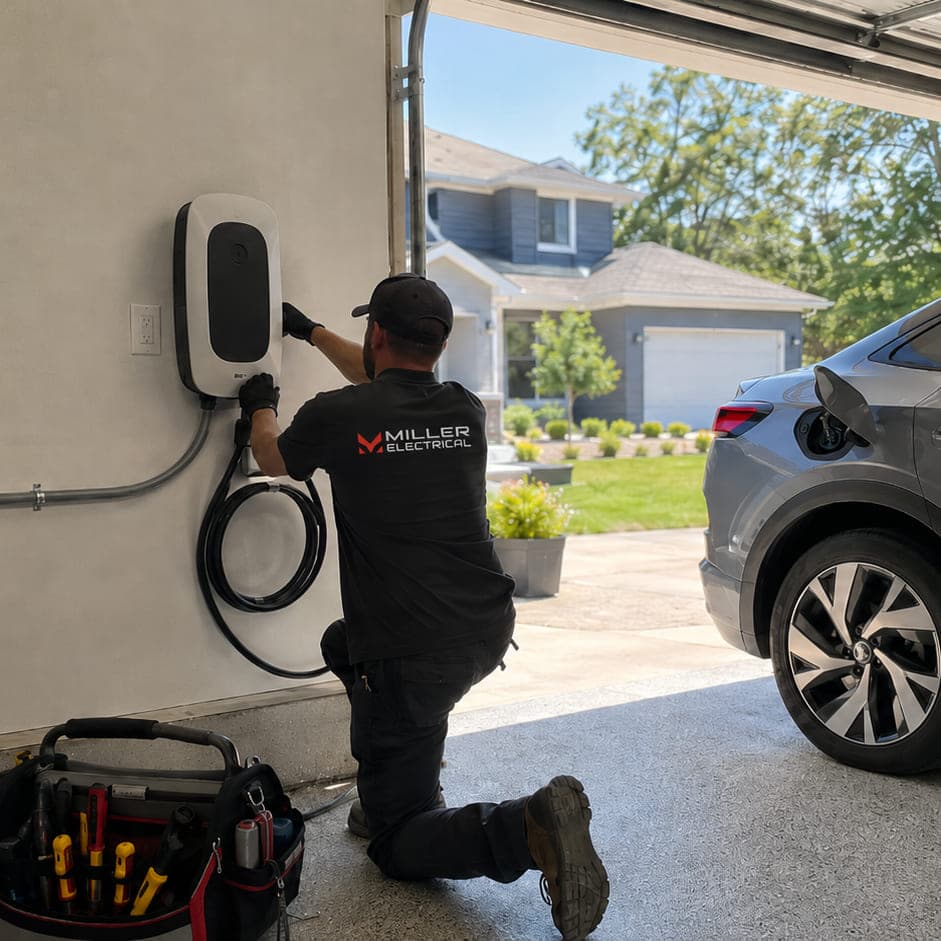
Level 2 home charging installed on a properly sized circuit, with a clean conduit run and a panel confirmed to carry it.
A Level 2 charger is a 240-volt circuit, done right
Installing a home EV charger means adding a dedicated 240-volt circuit sized for the charger you bought, running it cleanly from the panel to where the car parks, and confirming the panel can actually carry the new load. That last part is what separates a good install from a callback. Most Level 2 chargers ask for a 40-amp or 60-amp circuit, which is a meaningful addition to a panel that was sized long before anyone charged a car at home.
Miller Electrical runs a load calculation first, then quotes the install and, only if it is needed, the panel work to support it. We install hardwired and plug-in units, indoors and out, attached garages and driveway-side, and we handle the permit and the inspection. If your charger supports load management, we will tell you when that is the cheaper answer than a service upgrade, because sometimes it genuinely is.
Who this is for
New EV owners who want charging that finishes overnight without babysitting a 120-volt cord, and second-EV households where the existing setup no longer keeps up. If you are building or remodeling, this is the cheapest possible moment to run the circuit, even if the car is still a year away.
We also install workplace and multi-unit charging for commercial property owners, including multiple ports on managed circuits and the underground feeds needed to get power out to a parking area. That work often pairs with our own trenching and parking lot lighting crews.
What's included
The install is straightforward when the capacity question gets answered honestly first.
Load calculation and panel check
We confirm your service can carry the charger, and tell you plainly if it cannot, before you are committed to anything.
Dedicated 240V circuit
Correctly sized conductors and breaker for your specific charger, not a one-size guess that limits the charge rate you paid for.
Clean routing
Conduit and cable runs planned to look intentional, secured properly, and kept clear of cars, doors, and storage.
Hardwired or receptacle
Hardwired units or a NEMA 14-50 receptacle, with GFCI protection where code requires it.
Outdoor and detached installs
Driveway, carport, and detached garage installs, including underground feeds when the parking spot is not attached to the house.
Permit and inspection
Pulled, scheduled, and passed, which also matters for utility rebate programs and for resale.
Why Miller for EV charging
The charger is the easy part. Capacity, routing, and the panel are where the job is won.
- The same electricians who upgrade panels install the charger, so capacity and install get quoted together.
- We size for the charger you own and the loads you plan to add, not for the minimum that passes.
- We can trench or bore a feed to a detached garage with our own crews rather than subcontracting it.
- Licensed, permitted, and inspected, so a rebate application or a home sale has clean documentation.
FAQ
EV Charger Installation questions
Still have a question? Call us at (651) 538-4500 and we'll walk you through it.
The price is driven by the distance from the panel to the parking spot, how difficult that path is to run, and whether the panel has capacity. A charger on a wall ten feet from the panel is a very different job from one at the back of a detached garage. We quote after seeing the route and running the load calculation, and if a panel upgrade is needed we price it separately so you can see both numbers.
Sometimes, not always. A 200-amp service in a gas-heat home often absorbs a 48-amp charger without trouble, while a full 100-amp panel usually cannot. A load calculation gives the real answer. Where capacity is tight, a lower charge rate or a load-management device can be a legitimate alternative to a full service upgrade, and we will tell you when that applies.
Most straightforward installs are done in a few hours. Longer conduit runs, outdoor and detached-garage installs, and jobs that include panel work take longer, and anything involving trenching or boring is usually scheduled across more than one visit.
Hardwired units generally allow higher continuous charge rates and remove the plug as a failure point, which matters because a sustained 40-amp load on a consumer-grade receptacle is a common source of heat damage. A 14-50 receptacle is more flexible if you expect to swap or move the unit. We install both and will give you a recommendation based on your charger and where it is going.
Yes. We install multi-port and managed-circuit setups for commercial properties, and we can bring power out to a parking area with our own trenching and boring crews rather than waiting on a subcontractor to schedule it.
Request service
Let's get your project done right.
Tell us what you need and a Miller Electrical team member will follow up. Prefer to talk it through? Call us. We answer 24/7 for electrical emergencies.
- Licensed, bonded & insured · EA765664
- 24/7 emergency phone coverage
- Serving the Twin Cities metro since 1978
Request service
We'll get back to you fast. No obligation.